The control of several AI-agents is not merely about their deployment, it is about their coordination. In case the agents are working individually, the organization is not achieving the efficiency gains. They act in an uncivilized way when they combine their efforts without a well-planned orchestration.
The AI agent orchestration is a solution to this issue wherein it provides systems in which a number of AI agents can be coordinated towards a common goal. With the growth of enterprises between the pilot undertakings and deployment to production scales, the knowledge of orchestration architectures is of paramount importance. This guide explores the main three approaches namely, centralized, decentralized, and hybrid and conversational practical implementation patterns that dictate success or failure in real life settings.
What Is AI Agent Orchestration?
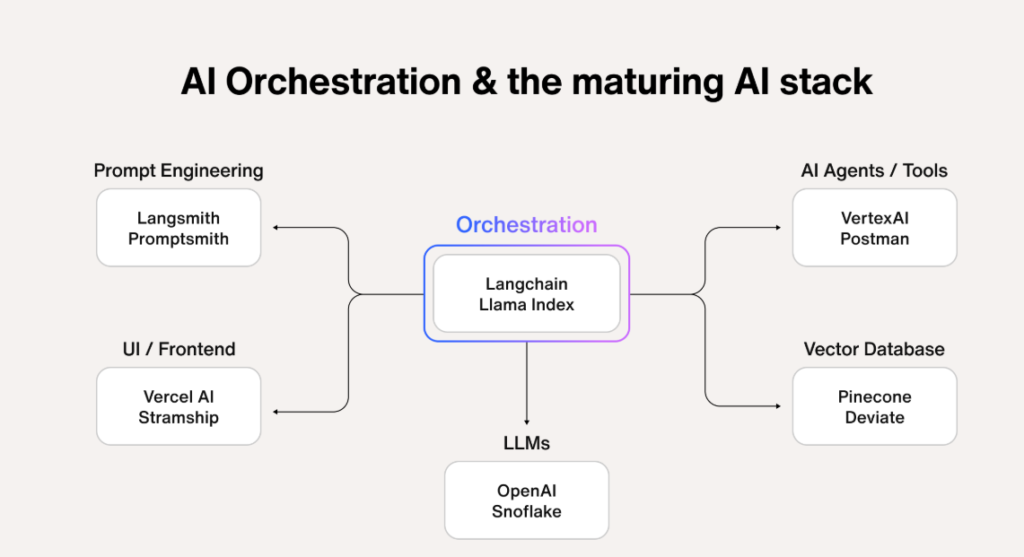
AI agent orchestration describes coordination mechanisms of allowing several AI agents to collaborate in achieving shared objectives. Imagine that it is the layer of management which defines how agents interact, take decisions and accomplish tasks in the multi agent systems.
The analogy of orchestra conductor is educational in this case. A conductor does not play music but makes musicians play together, taking control of the speed and changes in dynamics. In a similar manner, orchestration structures arrange agent interaction with no need to carry out the fundamental AI tasks.
Orchestration may however also be similar to improvisational jazz in which musicians listen and react to one another in an undirected manner. Other systems combine the two, where the coordination of strategic decisions is done in a structured manner but operational levels remain free to act as they see fit.
Why Orchestration Matters
Coordination is a complex activity that is exponentially increasing with the number of agents:
- 2 agents Simple direct communication is okay.
- 5 agents: Intermediate complexity; simple coordination is good enough.
- 20+ agents: Chaos is not well orchestrated.
- More than 100 agents: There is no way to control them without organized systems.
Studies suggest that about 70 percent of the companies have problems with regard to agent coordination. It is not just individual agents that work well in isolated tasks–modern LLMs and specialized AI models work remarkably in such tasks. The bottleneck is seen when the organization tries to expand past the proof of concept deployments.
There are three approaches to architecture that have arisen in response to these issues namely centralized orchestration (single coordinator model), decentralized orchestration (peer-to-peer coordination), and hybrid orchestration (layered approaches that combine both patterns). Both of the architecture have their own pros and cons, based on organizational needs, size and work potential restrictions.
Knowledge of these trends will be paramount to the person applying Agentic AI Explained: Multi-Agent Systems, Orchestration & Enterprise Automation at scale. The use of architecture is fundamental in determining the system behavior, performance characteristic and the results of its operations.
Centralized Orchestration: The Supervisor Model.
Centralized orchestration follows a paradigm of a master-controller in which one central agent, the supervisor, instructs all the subordinate workers agents. The supervisor obtains requests, allocates duties to the specialists, oversees their performance and generalizes outcomes and sends back the responses.
How Centralized Orchestration Works
The work process meets a pattern:
- Request Reception: The supervisor agent gets a request or job to be performed.
- Task Analysis: The supervisor analyzes the request to check the necessary capabilities.
- Selection of Agents: With the help of analysis the supervisor picks the right worker agents.
- Task Assignment: Supervisor assigns to the workers who have been selected certain tasks with instructions.
- Execution Monitoring: Employees will perform the given tasks, and the supervisor will monitor the progress.
- Result Aggregation: Supervisor gathers the results of all workers.
- Response Delivery: To provide finals results, and present the response, the supervisor synthesizes final results.
The example of a customer support scenario would be; when a customer calls support, a supervisor agent answers the customer, gets the type of issue, forwards technical inquiries to a technical agent, bills to a billing agent and account management to an account agent. Every specialist carries out his or her designated task and reports to the supervisor, which will be a compilation of the overall response.
The structure is that of a hub-and-spoke design. The supervisor is in the middle and his/her links directly to every worker agent. Employees do not interact directly among themselves, everything is organized under the leader.
Advantages of Centralized Orchestration
Unambiguous Control and Authority: The supervisor decides on all the coordination. This does away with confusion concerning which agent carries out particular actions or the dispel conflict among agents. The authority to make decisions is clear.
Simplified Monitoring: There is all-system visibility by one supervisor agent. Companies can also introduce full logging at a supervisor level to monitor all interactions of the agents, all the decisions, and the results.
Stability in Response Quality: The supervisor sets standards on all worker answers. This consistency is useful when dealing with customer-facing applications with brand voice and accuracy as important.
Simple Debugging: In cases of problems, there is troubleshooting where each problem is begone at the supervisors level. It is simpler to create a point of decision centralization to be able to track the problems back to their origin- was it the task assignment, agent selection, or execution by the worker?
Governance-Friendly: It is easier to regulate compliance, wherein the audit trails are channeled to one control point. This quality is appreciated by financial services organizations and healthcare organizations in particular.
Limitations of Centralized Orchestration
Performance Bottleneck: the request has to go through the supervisor, which will create an artificial bottleneck. With the growing number of requests, the supervisor clogs, which creates latency, lowering the user experience.
Single Point of Failure: In this case, the whole system becomes non-functional in the event of failure of the supervisor agent. The agents that are worker may exist, but they cannot be able to handle requests without coordinacy.
Scalability Limits: The architecture has troubles in the range of 10-20 agents. Each new employee added to the supervisor reduces the cognitive load, and more complex decision logic is needed, as well as less computational resources.
Latency It is greater: Every interaction is enabled by passing through a supervisor. In time-sensitive applications, this extra latency may just not be acceptable, particularly where complicated work processes involve several coordination cycles.
When to Use Centralized Orchestration
Centralized designs are efficient in:
Small-scale Deployments with less than 15 agents Humbled bottlenecks are small enough to be managed.
- Unequivocal hierarchical needs: Well-defined hierarchic control structures and decision-making chains.
- Simple workflows Processes with assignment of tasks that are predictable.
- Regulatory: Industry that should have a detailed audit trail and governmental controls.
- Preliminary deployments: In where agent orchestration trips Organizations that initiate their journeys with centralized simplicity progress to more complicated patterns.
I have implemented centralized orchestration in initial implementation, and the simplicity of the pattern fast-tracked initial deployment. But the degradation of performance was observed to be significant at around 12 agents count, which required architectural evolution.
Decentralized (Mesh) Orchestration: Peer-to-Peer Coordination
The centralized model is inverted by the decentralized orchestration. There is no particular coordinator. Rather, agents work independently and they interact peer-to-peer in an attempt to achieve common goals. Independent decision making is used as each agent decides on the tasks to be performed and other agents to cooperate.
How Decentralized Orchestration Works
Workflow is organized in a decentralized manner, and it functions in a completely different way:
- Request Distribution: Entries of requests are done as per the available agents into the system.
Autonomous Assessment: It does an evaluation of the receiving agent to determine its ability to process the request. - Peer Discovery: In case of the requirement of collaboration, the agent determines the appropriate peer agents.
- Direct Negotiation: The direct agents discuss with each other and help to set up the task allocation.
Parallel Execution Multiple agents are doing parallel work on various parts. - Result Sharing: Agents share information and intermediate results upon demand.
- Consensus Building: In the situations where there is need to make decisions, agents rely on consensus protocols.
An example of a supply chain optimization setting: In a demand forecasting agent, anomalous changes in patterns are identified. It has a direct connection to inventory management agents in various warehouses which also communicates with logistics agents to evaluate the transportation capacity. The agents of pricing are asked into the table to consider competitive positioning. Without centralisation, all the agents negotiation is aimed at optimising the supply chain response.
It looks like a mesh network whereby every agent is connected to pertinent peer agents. Communication channels develop naturally according to the task needs and not as per the hierarchies.
Advantages of Decentralized Orchestration
High Scalability: The system is also scalable by default, adding additional agents. It is possible to add agents to the system and the performance is nearly linear rather than decreasing in terms of agents because there is no central bottleneck.
Self-Mending Sturdiness: In the event of individual agent failure, the system keeps operating. The failure is sensed by peer agents that are aware of failures and redirectring to the healthy agents.
Eradication of Single Points of Failure: There is no divine central component. The system can withstand a number of concurrent agent failures without being fully degraded.
Low Latency: P2P communication without intermediaries is termed as low latency. Agents do not have to wait to be processed by coordinators to exchange information with others, but instead do it at the pace of direct network connections.
Adaptive Learning: The agents learn through interactions with other peers and find more efficient patterns of collaboration, as time progresses. The system is made smarter by experience.
Operational Resilience: The architecture is designed in a way that an environment based on dynamic requirements where the requirements vary quickly, agents join and leave; workloads move in and out.
Drawbacks of Decentralized Orchestration.
Benign Monitoring: It gets complicated to monitor with no log centralization. To analyze system behavior, there is the need to compile the information of many autonomous agents that possess limited knowledge.
Difficult Debugging: Searching of issues in peer-to-peer interactions is complex. Root cause analysis can be challenging because emergent behaviors can cause issues as opposed to failure by single agents.
Consistency Challenges: Co-ordination at an agent level: it is very difficult to have compatible decisions made without involving coordination mechanisms. When agents maximize the different goals they may create conflicts.
Complexity of Protocol: It requires strong collaboration protocols among agents so that they can negotiate. When writing these protocols, it is necessary to have them designed with careful consideration of the failure modes, timeouts as well as deadlocks.
Compliance Challenges: It is more challenging to prove that there is regulatory compliance in a situation where an individual audit trail does not exist. Companies are required to carry out distributed logging and reconciliation.
Prolonged Implementation Period: Decentralized systems take more time to design. Peer-to-peer coordination is a complicated challenge so teams usually require greater development time than centralized strategies.
Limitations of Decentralized Orchestration
Decentralized designs are good when they serve the purpose of:
- Large-scale systems: Deployments that have 20 or more agents and they would cause bottlenecks with a centralized coordination.
- Complex workflows: Processes with changing context-dependent pattern of collaboration.
- High resilience: Applications in which availability of the system is of greater importance than simplicity in operation.
- Operation autonomy requirements: Situations in which agents are supposed to work without supervision at all times.
- Lack of central power: The scenarios in which decision-making must not be in the hands of a certain force.
My experience revealed that decentralized strategies need much more planning in architecture but have a higher performance at scale. The payback period occurs once there is over 2530 agents counted and system resiliency becomes a key factor.
Hybrid Orchestration: Balancing Control and Autonomy
Hybrid orchestration incorporates the best ideas of centralization and decentralization. The architecture has been built in such a way that there are coordination layers and the central oversight offers strategic guidance but the operation is done at the lower levels.
How Hybrid Orchestration Works
Hybrid Systems form agent hierarchies:
- Strategic Layer: There are the high-level coordinator agents which establish objectives and constraints.
- Tactical Layer: Intermediate level supervisor agents relate to functional domains.
- Operational Layer: The worker agents can perform particular jobs with local autonomy.
- Cross-Layer Communication: Vertical flow of communication takes place across the layers; horizontal flow of communication is done across peers within the same layer.
- Delegated Decision Authority: The levels will make decisions that are relevant to the levels.
- Escalation Pathways: This involves complex or extraordinary cases that need to be taken to a higher level.
- Aggregated Reporting: Finds its way to the synthesis ladders.
The examples of this trend are large financial institutions: A chief orchestrator agent establishes enterprise-wide goals (strategic layer). Trading, risk management, compliance and customer service domains (tactical layer) are under management of department supervisors. In each department, there are specialized agents who are in charge of certain functions independently and collaborate with peers (operational layer).
The trading agents also may work in a peer-peer basis in order to carry out the strategies, though they may rise to the trading supervisor at the risk limit threshold. The compliance supervisor consults the supervisor prior to significant decisions, and either can take the issue up to the chief orchestrator to find out the implications at an enterprise level.
Advantages of Hybrid Orchestration
Control with Scalability: Organizations have the option to go to 100+ agents without relinquishing its strategic control. The hierarchical organization shares the burden of coordination among several supervisor agents.
Balanced Governance: The Central layers have audit trails and compliance controls and the Operational ones have flexibility and speed. This meets the regulatory as well as performance requirements.
Proper Latency: Strategic decisions that tolerate some latency travel over central layers; operation decisions that are sensitive to time are implemented using peer-to-peer speed.
Well-defined Organizational Structure: It is clear that the hierarchical model takes the shape of organizational structure of enterprises, and system design is more understood by the stakeholders.
Opportunities of Specialization: The opportunities of specialization can be optimized by different layers to achieve varying goals. Strategic layers are long-term oriented, operational layers are short-term oriented.
Fault Tolerance: Operational layers are resilient and peer coordinated on higher layers by reducing systems failure through supervisor redundancy.
Limitations of Hybrid Orchestration
Implementation Complexity: To design effective layer boundaries, one should be analysed thoroughly. The lack of a good layer design can confuse the users on which agents to perform certain decisions.
Greater Number of Components to Control: Greater number of supervisors agents entails greater infrastructure to monitor, update or maintain. There are higher operational overheads than pure centralized or decentralized.
Risk of Organizational Silos: Various areas may streamline at the local level without looking at the overall effects on the enterprise. Action coordination across domains must be made very clear.
Challenges in Designing the Layer: The determination of bounding delegation is a challenge. Excessive centralization is the same as re-creation of bottlenecks; whereas excessive autonomy denies us the advantages of co-ordination.
Potential Layer Bottlenecks: Each of the tactical layer supervisor agents can be a bottleneck based on whether it is not properly load-balanced or the delegation is not fine enough.
When to Use Hybrid Orchestration
Hybrid architectures suit:
- Enterprise scale: Organizations with 100 or more agents in various functions in the business.
- Various departments: Organisations that require autonomy of different departments but they have to be strategically coordinated.
- Governance and flexibility: Cases where the need is regulatory compliance and the need is not to be crippled by the performance agility.
- Multifaceted organizational organization: Firms with a hierarchical structure, which must be respected by the agent systems.
- Mature deployments– these organizations are those that evolve to more complex architecture when they grow beyond their initial constraints.
I observed hybrid patterns to be naturally occurring in most large-scale environments I looked at. Hybrid systems are rarely planned with organizations often developing into them as they find constraints of either extreme method, centralized and decentralized.
Orchestration Patterns in Practice
In addition to architectural decisions, there are particular patterns of execution, which define the coordination of agents in selected architectures. These patterns may be combined and interchanged in various regions of a system.
Pattern 1: Sequential Handoff
What It Is: Work is processed sequentially by the agents on one at a time. One agent, Agent A, fulfills his or her job and transfers to another, Agent B, who processes and transfers to another agent, Agent C and so on.
Using example Implementation, Document approval workflow:
- The submission is validated in intake agent.
- Content is reviewed by specialist agents and recommendations added.
- The approval agent compares to policies.
- Execution agent Processes the approved document.
Advantages:
- Determinable flow: Every stage has a strict order that is determined.
- Simple to comprehend: Stakeholders have the ability to see the whole process in a straight line.
- Basic debugging: Issues are usually found in particular handoff points and thus, troubleshooting is easy.
Disadvantages:
- Delays in implementation: The total implemented time is the aggregate of all the temporal steps.
- Bottleneck amplification: Sluggish actions obstruct the entire downstream agents.
- Minimal parallelization: The agents are only used by one agent at a time.
It is best applied to processes that demand rigid order, approval chains, procedures where every step in the process can be wholly dependent on the final output of the preceding process.
Pattern 2: Concurrent Parallel Execution
What It Is: Multiple agents process the same input or multiple aspects of a problem at the same time. When all parallel agents are done a coordinating agent sums up the results.
Template implementation: Fraud detection system:
- Transaction monitoring agent is the analyzer of transaction trends.
- Behavioral analysis agent estimates the abnormal user behavioral patterns.
- Location based risk factors are checked by geographic analysis agent.
- The all the agents execute the same transaction.
Advantages:
- Time-saving on completion speed- The overall time it takes is minimized through parallel execution to slowest agent.
- In-depth evaluation: There are various viewpoints which yield deeper assessment.
- Resource efficiency: optimizes the operating resources.
Disadvantages:
- Aggregation of results This is the complex aggregation of multiple agent results.
- Synchronization overhead: System has to wait till all the parallel agents are done.
- Potential contradictions: There can be conflicting agents who produce some contradictory recommendational statements that need a resolution.
Best Used For: The blue ocean approach is used when multiple perspectives are needed in analysis, time-sensitive decisions to be made, and subtasks are actually independent in workflows.
Pattern 3: Hierarchical Routing.
What It Is: A decision tree is a process that involves the identification of the agent that processes a request via characteristics. Routing logic will help the requests to guidance towards the most competent expert without engaging agents that may be irrelevant.
Exemplary Implementation: Customer service system:
- Router agent analyses incoming request.
- IF account type is VIP, then route to VIP service agent.
- ELSE IF the type of issue is technical THEN channel to technical support agent.
- ELSE IF issue-type is billing then go to billing agent.
- ELSE promote to general service agent.
Advantages:
- Efficient resource utilization: Only agents that are relevant handle individual request.
- Quick responses: There are no unnecessary hops and requests target specialists.
- Simpler agent specialization:All agents specialize in particular fields.
Disadvantages:
- Complexity of Routing logic Decision trees become complex due to the spread of rules.
- Maintenance load: The need to add new types of agents or routing rules causes the system to be updated.
- Misroute risk: The mis-routing decisions result in sending requests to the wrong agents and should be re-routed.
Applicable best in: Customer service, support systems, situations where there are categorization rules, workflows where expert knowledge in the specialty may be of importance.
Pattern 4: Group Chat Collaboration
What It Is: There is a common dialogue between multiple agents, each responding to the output of other agents. Agents engage in the development of responses on that which was previously answered, pose clarifying questions, and refine solutions together.
Example Implementation: discussion of financial planning:
- Portfolio allocation is suggested by investment agent.
- Tax agent determines tax implications, tax optimization.
- Risk agent examines the risk exposure and recommends modification.
- Checks regulatory Compliance agent checks regulatory requirements.
- Agents repeat a number of rounds until they come to agreement.
Advantages:
- Interpersonal problem solving: It involves several viewpoints as a result of discussion.
- Dynamic adaptation: Agents are dynamic in the way they adapt recommendations.
- Development of alternatives: Group discussion involves exploring various avenues Inevitably comes with the possibility of having various solutions.
Disadvantages:
- Ineffectiveness: Discussions may go on and on without a clear booking out criterion.
- Coordination overhead: Multi-agent conversations can only be coordinated by using advanced protocols.
- Possibility of circular discusussion: Risk They can fail in the design process and have the agents cycling the same arguments over and over again.
Best Applied: Problems where the best answer is not apparent, situations where it is an advantage that various professionals are present, the exploratory analysis, strategy formulation.
Pattern 5: Validation of a Feedback Loop
What It Is: The first agent produces an output and the quality is checked by a validation agent, when the validation fails, this output goes to a generator to be refined. It goes round and round till the validation occurs or the maximum iterations are completed.
When running on a standard computer, it can execute the following command: Content generation system:
- Article draft is created by writer agent.
- Draft is checked by agent by quality criteria.
- IF the quality score of the score is less than threshold THEN provide certain feedback to the writer agent.
- Writer agent is a member of the revision group.
- Repeat process till quality is achieved.
Advantages:
- Quality assurance: In-built validation will ensure that the outputs are up to standard.
- Iterative enhancement: Each of the cycles enhances the quality of output.
- Automatic correction: Correction is done automatically, and without the interference of the human being.
Disadvantages:
- Smaller turnaround time: Multicast processing time.
- Convergence uncertainty: Workflow convergence might fail to reach acceptable quality.
- Consumption of resources: Numerous number of revision cycles use additional computation resources.
Best: Content Generation, Data processing that needs validation, workflow in which quality is more important than speed, systems that are subject to an iterative improvement process.
Choosing Your Orchestration Architecture
The correct orchestration architecture can only be selected by straightforward evaluation of organizational needs, technical limitations and practical realities.
Key Assessment Questions
What is the number of agents to be coordinated by the system?
- 2-10 agents: The centralized methods achieve wellness.
- 10-30 agents: Think of the hybrid patterns or the lightweight decentralization.
- More than 30 agents: Architectures must be decentralized or hybrid in nature.
- More than 100 agents: Hybrid patterns containing several coordination layers are the best to manage.
What are the complexity of workflow?
- Basic linear operations: Sequential patterns, centralized.
- Routing patterns and moderate complexity with some branching: Routing patterns Centralized routing
- Adjusting to dynamic workflow: Hybrid or decentralized workflow.
- Very complex and emerging cooperation: Decentralized patterns.
What are the requirements of failure tolerance?
- Minimal acceptable availability: Architectures that are centralized are good enough.
- Requirement of high availability: Have redundant supervisors in centralized /hybrid.
- Always-on mission critical operation: The best resiliency in decentralized patterns.
- Zero tolerance level of full outages: Decentralized mesh with redundancy at all levels.
What does the governance and compliance require?
- High regulatory diligence: Simplified audit trails are achieved through a process of centralization.
- Moderate compliance needs: Hybrid and centralised strategic layer.
- Selectively formal needs: Decentralized patterns that can work with adequate logging.
- Should be able to prove the decisions: Centralized or hybrid with full logging.
What is the structure of the organization?
- Flat organisation structure: The patterns are naturally mapped as decentralised.
- Evident departmental divisions: Hybrid with domains that are equal to departments.
- Both centralized and hybrid respecting hierarchy Strong hierarchical culture.
- Federated autonomous units: Within-unit, cross-unit, hybrid.
Decision Matrix for Common Scenarios
Scenario: Startup on its NarCity initial multi-agent system.
- Agents: 3-5
- Complexity: Low
- Recommended: Centralized
- Reason: It can be deployed quickly; it is simple to monitor and debug.
There is a scenario where a mid-sized firm is automating customer support.
- Agents: 8-15
- Complexity: Moderate
- Suggestion: centralized routing and hierarchical routing.
- Justification: There are established follow or route guidelines; audit trail is important when dealing with customers.
Scenario: Big financial organization that has several units of business.
- Agents: 50-100
- Complexity: High
- Recommended: Hybrid
- Reasoning Rationality demands layers; governance requires supervision; business units must be free.
In this scenario, we assume Tech company is constructing a resilient real-time trading platform.
- Agents: 30-50
- Complexity: Very high
- Recommended: Decentralized
- Reason why: Latency-sensitive/High availability needed/Dynamic market environment necessitates change.
Scenario: healthcare system that is highly HIPAA compliant.
- Agents: 20-40
- Complexity: High
- Hybrid with centralized compliance layer should be proposed.
- Rationale There is regulatory mandate that oversight must exist; clinical departments require functional autonomy; overall audit trails are imperative.
Real Implementation Path
With most successful deployments there is an evolutionary approach:
Phase 1: Centralization ( Months 1-3) Foundation.
- Dispersal of 3-5 core agents with central supervisor.
- Define a monitoring and logging as well as practices of debugging.
- Check business value on small scale.
- PASS Insurance Bottlenecks, scaling constraints.
Phase 2: Selected Hybrid Introduction (Months 4-9)
- Find areas where operational autonomy is of value.
- Implement domain supervisors on those areas with heavy work.
- facilitate coordination among peers at domains with strategic control centrally.
- Every domain Scale to 15-30 agents.
Phase 3: Here is where Day Being informed (Months 10+) and Decentralized Patterns
- Embark on the concept of peer-to-peer patterns to have operations that are truly autonomous.
- maintain co-governing control of critical functions of governance.
- Grow to route requirements of size 50 or more.
- Fine-tune on a continuous basis using operational data.
The given evolution strategy minimizes the risk, but it also enables companies to explore their unique needs by means of actual deployment.
Implementation Considerations
In addition to architectural choice, there are a number of factors, which are critical determinants of success in orchestration.
Communication Protocols
Agents must have standard ways of information exchanges. Two protocol standards are taken into consideration:
Model Context Protocol (MCP) is a standard that represents the way in which agents interface with external tools, databases and APIs. Instead of having all the frameworks to come up with unique integrations, MCP offers a standard interface to have a uniform agent to tools communication. The protocol is based on JSON-RPC 2.0 and operates either over stdio or Server-Sent Events and is supported by various models and architectures or AI.
The Agent-to- Agent Protocol (A2A) allows the agents of other vendors to interact with each other smoothly. A2A unlike MCP (which is concerned with agent-to-tool relationships) deals with issues of inter-agent communication, inter-agent negotiation, and inter-agent task-sharing. It promotes dynamic discovery in which agents discover the capabilities of each other at run time.
These norms require structures that need to be nurtured in organizations. The interoperability makes the vendor lock-in minimal and enables mixture of agents between various ecosystems without any specialist integration efforts.
Monitoring Complexity
Various schemes of architecture need varying methods of monitoring:
Centralized Monitoring: Go to the supervisor agent. Introduce extensive logging in the point of coordination. Request routing, worker agent, tasks assignment, execution time and quality of results.
Decentralized Monitoring: Also do distributed tracing to all the agents. Quality: peer-to-peer interactions also help to keep track of request execution using correlation IDs. Centrally aggregate logs to analyze them and leave the individual agents independent of one another.
Combine both methods Hybrid Monitoring. Coordination patterns at any layer are monitored with supervisor agents and distributed tracing is applied to peer-coordinated operational agents.
The health of the agent, request throughput, error rates, average latency and queue depths should be displayed on real time dashboards. The anomalies of an unusual rise of latency, the high rate of errors, or agents failures are also set with automated alerting triggers.
Testing Approach
Orchestration systems are particularly difficult to test:
Unit Testing: Check the behaviours of specific agents in isolation to ensure they give the expected behaviour with specific inputs. Mimicked dependencies and external services.
Integration Testing: Test the validity of agent-to-agent communication protocols. Patterns of data handoff, compatibility of data format, and error handling.
End-to-End Testing: Test an entire workflow beginning with an initial request and delegating on through to the final response. Performance measurement Test realistic data volumes.
Chaos Testing: Due to the effects of resilience, cause failures (agent crashes, network problems, slow responses) extensions. Chaos testing is especially advantageous to decentralized systems because it can be used to test the self-healing properties of the system.
Load Testing: Find out how well it can perform with more and more request volumes to determine what is leading to the problem, and prove the performance claims made in scalability.
Scaling Timeline
Plausible goals with regard to scale prevent disappointment:
Months 1-3: Implement the first centralized system consisting of 3-5 agents. Eliminate on demonstrating business value and elucidating business practice.
Months 4-6: Scale to 10-15 agents. Start having the hassles of coordination that will encourage the development of architecture.
Months 7-12: Add the patterns of hybridity or change to the decentralized strategies where necessary. 20-30 agents on various domains.
Year 2+: Keep increasing the number of agents to 50+ and above agents that have mature patterns of orchestration. Optimize by use of operating data and feedback.
Organizations that have tried implementing 50+ agents at once almost always have difficulties. The complexity of orchestrations discourages its learning curve, which makes incremental scaling a good decision.
Cost Implications
The cost profile of the different architectures is different:
Centralized Costs: Decrease in the operational costs due to lower infrastructure complexity. Nevertheless, the bottlenecks in performance can necessitate over-provisioning the supervisor agent with an increase in the cost of compute.
Decentralized Costs: Greater complexity in infrastructure creates overhead in the operation. Nonetheless, at scale, the combined cost of compute can be reduced through effective resource utilization (no central bottleneck).
Hybrid Costs: A majority of sophisticated infrastructure on the ground needs dedicated operations team. At enterprise scale, favorable returns are realized at the point where cost optimization of 100+ agents is justified to invest in operations.
The cost of LLD API commonly prevails over expenses. Caching can be immediately implemented, smaller models can be used to solve well-defined smaller tasks, and when possible requests can be batch to manage costs.
Conclusion: Orchestrating your AI Agent Future.
The organizational of AI agents has ceased as an experimental desire and become essential to production. Through this, organizations that roll out multiple agents without the co-ordination of such agents are bound to experience chaos as the systems expand beyond proof-of-concept requirements.
The three major architectures which are centralized, decentralized and hybrid are related to the various needs of the organization. Small systems have easy control and operator patterns which are centralized. Large, autonomous operations are provided with scalability and resiliency with decentralized patterns. Hybrid patterns potentially provide better balance in between control and flexibility when deploying to an enterprise.
Changing architecture to fit the real needs is the way to succeed as opposed to the trends. A customer service system of five agents does not require a complex system in which there is a decentralization. The centralized bottlenecks will not work in a 100 agent enterprise platform.
Begin with simplicity, which is centralized. Understand how to work on the job. Only when there is a scale pressure that they committed to increasing complexity evolve to take on hybrid or decentralized patterns. This component of evolution lowers risks but develops organizational capabilities in gradual steps.
The orchestration constructs, communication structures and architectural designs mentioned below serve as a guideline in making informed decisions. Nevertheless, each instance of an organization has its unique situation, and requirements in the industry, technical limitations, the abilities held by a team, and business goals ultimately decide the most effective one.
Those companies that get strategic about agent orchestration stand to reap significant value on AI investments. Those who transplant agents in ad hoc mode with no coordination schemes encounter increasing technical debts and state of anarchy.
It is not a question of whether orchestration should or should not be implemented; it is just how orchestration architectures can be arranged to attain both organizational realities and future scalability requirements.
Next Steps
Organizations which are starting the journeys of orchestration are supposed to:
- Analyze the existing situation: Identify the number of agents, note the workflows, establish coordination issues.
- Define requirements: Decode intention of scale desired, failure requirements, governance requirements.
- Select initial architecture: This can be either centralized (lowest complexity) or 7# hybrid (known scaling demands).
- Introduce monitoring: Have elaborate logging and observability in place at the start-up.
- Plan development: Reported projected development and building development drivers.
Expect nothing much, learn much faster – Pick up and start with the minimum orchestration, collect operational data,build upon what you know.
Factors leading to successful orchestration involve one agent interaction being well coordinated. Construct on it carefully, meticulously, and with constant improvements.
To gain a further insight into AI agent structures and implementation policies, the IBM AI Agent Governance Guide offers extensive governance policy guidelines necessary to implement AI agents in enterprise.
Architectural advice Organizations interested in architectural advice need to see the Microsoft Azure AI Agent Design Patterns documentation, which contains reference architectures and examples of real-world implementation in the financial services, healthcare and telecommunications industry.

I’m software engineer and tech writer with a passion for digital marketing. Combining technical expertise with marketing insights, I write engaging content on topics like Technology, AI, and digital strategies. With hands-on experience in coding and marketing.