At the time when a business tech meetup was first discussed, where someone first told of smart contracts, the response was largely incomprehensible looks. Contracts that are… smart? Calling it something of a sci-fi film, right?
The thing is that with smart contracts, it is not intelligence that is at play. They’re about automation. Imagine they are a form of digital contract, which silently executes itself when certain criteria are fulfilled, no attorneys, no intermediaries, no long chains of emails whose subject is that we are waiting the other person to sign.
This technology is beginning to make sense particularly to businesses that have repetitive transactions, supplier payment, or those that have compliance headaches. Smart contracts have already been implemented by about 12% of the large businesses, and the figure is rapidly increasing.
So What Are Smart Contracts?
Removal of the buzzwords will leave you with something that is very easy to understand: code stored in a blockchain which automatically executes functions when specific criteria are fulfilled.
The classic comparison? A vending machine. You put in some cash (condition met), the machine passes out your snack (execution). No cashier needed. No trust required. The machine just… works.
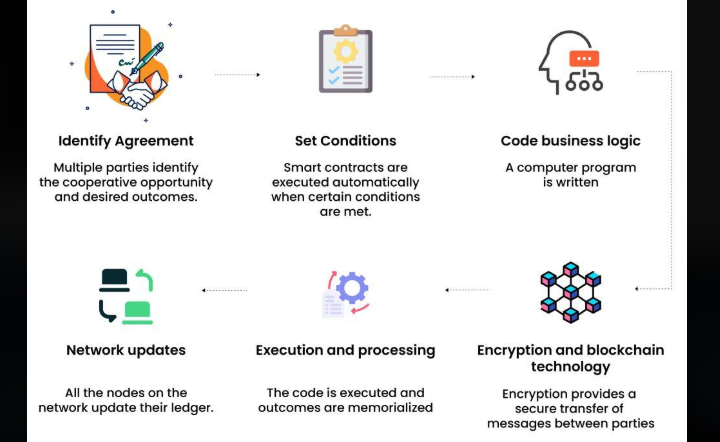
Smart contracts work according to the same principle:
- Contract terms are coded in such languages as Solidity.
- Code is implemented to a blockchain, where it cannot be manipulated.
- The contract is watched by tracking conditions 24/7.
- Actions are carried out when the conditions are met.
- All has been stored permanently in the blockchain.
Real life situation: A supplier transports goods to your warehouse. An IoT sensor ensures arrival. They are smart contracts in which the payment is released automatically. No invoices. No approval workflows. There shall be no 30-day payment terms that become 60 days at all.
How Smart Contracts Actually Help Businesses
Automation That Actually Works
Paperwork is time and cost consuming. It takes somebody to verify, approve, process, confirm and document each and every transaction. This is automatically tackled by smart contracts.
Hyperledger fabric has been noted to bring significant efficiency to supply chain companies. The IBM system, Trust Your Supplier, reduced the months to days time spent onboarding suppliers. Not just a small improvement that is transformational.
The automation extends to:
- Collection of payment in case the conditions of delivery are fulfilled.
- Checking adherence to regulations.
- Performance-based contract renewal.
- Supplier inspection and control.
Cost Savings You Can Measure
Intermediaries cost money. Lawyers for contract review. Brokers for transactions. Auditors for verification. Payment process payment banks.
The majority of these functions are removed by smart contracts. Depending on the industry, business reports a reduction of 20-50 percent of the costs. Fact is, that is money on the bottom.
Also, there are the indirect expenses: overhead, corrective measures, dispute resolution. These costs do not exist when there is the execution of contracts through verifiable conditions that will automatically occur.
Market Data That Grows Trust.
All the transactions of a blockchain can be seen by the authorized entities. No hidden changes. No disputed terms. No “I did not say so in the first place” arguments.
This accountability is formed through this transparency. The Marco Polo Network applies philanthropic smart contracts in trade finance to make all records of the transaction exactly similar to all the parties. Disputes drop. Trust increases. Business moves faster.
The Technical Reality (What You Really Need to Know).
Blockchain Foundation
Smart contracts run on blockchains- distributed networks which would be extremely difficult to temper with. The contract can never be secretly amended once implemented. This fixity gives it safety but causes difficulties in the event of bugs being found.
The blockchain provides:
- Decentralization (there is no one central place of control)
- Cryptographic security (guaranteed against violation)
- Open implementation (all of them see the same data)
- Permanent records (it is impossible to clear transactions)
The Oracle Problem
Here the difficult thing comes in. Smart contracts do not have any connectivity to reality. They require the support of a set of oracles, which inject exogenous information in the blockchain.
When an oracle malfunctions or gives misleading information, this contract malfunctions. Likely reasons are solutions such as Chainlink based on decentralized oracle networks, however this would be an important point to consider.
Security Considerations
The 2016 Dao hack has shown that code vulnerabilities are devastating. Hundreds of millions were lost by a lever which could be pushed. The best practices are now required to be:
- Onboarding professional audits.
- Formal checking (mathematically demonstrating that a proposition is correct)
- Intelligence based on automated vulnerability.
- Critical action wallets- multi-sign.
- Important executions have time locks.
Improper coding is the root of about 70 percent of the vulnerabilities, which gives the necessary development to the experts.
Current Business Applications in Reality.
Supply Chain Management
Such companies as Hitachi introduced paperless procurement based on the blockchain and enhanced efficiency and fraud reduction. All the steps are automatically traced. Issuance of payment on condition fulfillment. Adherence occurs on a real-time basis.
Trade Finance
The Marco Polo Network executes trading finance communications via Corda blockchain. The exporters and importers will have their access to faster working capital. Manual errors drop. The speed of transactions becomes very huge.
Energy Trading
Power Ledger was integrated to operate as peer-to-peer energy trading with Google Cloud. Individuals that have solar panels will be able to sell surplus energy to their neighbors. Smart contract processes metering, pricing, and payment in automatic mode.
Real Estate
The tokenization of property removes the services of traditional brokers. Smart contracts hold closing processes, which saves time and costs of transactions.
What’s Coming in 2025 and Beyond
AI-Powered Contracts
Smart contracts are becoming adaptive with the help of artificial intelligence. AI-enhanced contracts can:
- Automatically interpret non-reader-friendly legal text.
- Identify weaknesses prior to implementation.
- Modify terms on-site information.
- Optimize execution timing
The Acrobat AI Assistant recently introduced by Adobe enables the use of complex terms made understandable by non-technical people through intelligent contract options.
Cross-Chain Functionality
Initial smart contracts only existed within single blockchains. The contracts can even run across networks through platforms, such as Polkadot and Cosmos, now removing fragmentation.
Legal Recognition
In a few states in the U.S. such as Arizona, Wyoming and Texas specifically acknowledge that smart contracts can be legally enforced. The UCC Article 12 offers the understanding of digital assets and the transactions at the interstate level.
The Catch (Because There’s Allway a Catch).
Immutability Cuts Both Ways
Not easily able to change deployed contracts. In case bugs are found, they need complicated work-around or blockchain forks to resolve.
Regulatory Uncertainty
There are a lot of jurisdictions that do not have clear structures. The practice of AML, KYC, and data protection laws becomes tricky particularly at the border.
Technical competence.
The development of secure smart contracts requires blockchain technology, cryptography, and Solidity programming. Errors cause losses of funds.
High Initial Costs
Deployment fees vary. Ether Checking 50-500 according to the level of network congestion. Project development will need blockchain developers, security auditors, and law consultants who are conversant with blockchain laws.
Should Your Business Actually Use This?
Smart contracts do make sense when your business process:
- Has is obviously rigid with unrestricted conditions.
- The advantages of automation and speed.
- Associates with more than two parties having trust issues.
- Needs Auditable records.
- High transaction volume deals.
They’re poor fits for:
- Multifaceted negotiations which entail human judgment.
- The changing rules of business are frequent.
- Flexible processes are required.
- Poor quality of data situations.
Getting Started (If You’re Ready)
Go small: Find a high-impact use case. Automate supplier payments. Track compliance. Streamline procurement.
Focus on security: Clock in professional auditors. Budget for thorough testing. It is important to remember that 70 percent of vulnerabilities are due to coding errors.
Assemble the appropriate team: You will be required to employ blockchain developers, security researchers, lawyers and product managers who know technology and business.
Choose your platform wisely:
- Ethernet to develop ecosystem and large-scale tooling.
- Cross-chain required of Polkadot or Cosmos.
- Hyperledger Fabric of private and permissioned networks.
Measure what matters: Measure reduction of transaction costs, reduction in the time of doing business, eradication of error and savings by an intermediate.
The Bottom Line
Smart contracts aren’t magic. They are automation applications that carry not so mild possibilities and actual restrictions. The technology brings valuative value to businesses that have repetitive processes, different mediators, and have mistrust among them.
The legal systems are coming out of age. The security practices are on the increase. There is increased cross-chain functionality. Contracts are becoming smarter and more accessible with the integration of AI.
Success takes planning, highly skilled implementation, realistic preparation though. Viable use cases should begin with well-defined use cases. Invest in security. Assemble interfunctional teams. And measure results rudely.
The question is not whether smart contracts will change the manner in which business is done, it already does. The question is, are your business requirements in line with what the technology is good at?

I’m software engineer and tech writer with a passion for digital marketing. Combining technical expertise with marketing insights, I write engaging content on topics like Technology, AI, and digital strategies. With hands-on experience in coding and marketing.