Last updated on December 21st, 2025 at 10:22 am
The very first thing that came to my mind when I heard that there was the RTX 5060 Ti 16GB was that I rolled my eyes. A second mid-range GPU that attempts to explain its existence in 2025?
However, there is a twist to this matter this card is not targeting gamers. It is an AI laborer that just plays games by the side.
What You’re Actually Getting
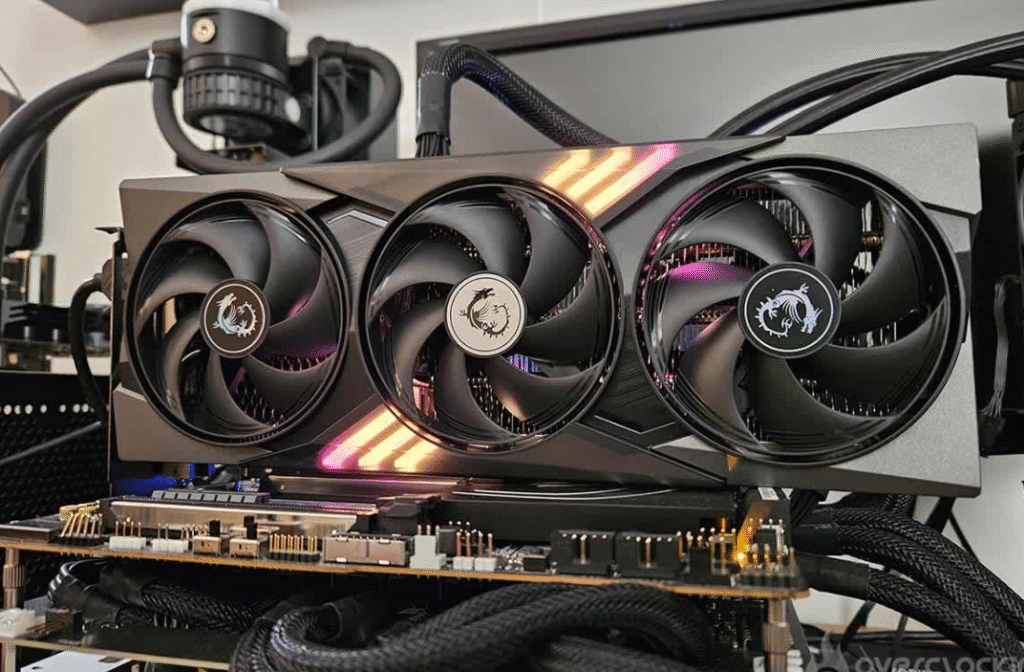
MSI GeForce RTX 5060 Ti 16GB, which released in April 2025 at a price of $429, is not without some interesting specs. It has 4608 CUDA cores, 16GB of GDDR7 memory with a speed of 28 Gbps, and 180W power consumption. Sounds decent, right?
However, this is what caught my eye: 759 AI TOPS and 5 th Gen Tensor Cores. It is not game hardware that, but AI muscle in a gaming GPU casing.
Nice variants that MSI has. Gaming Trio OC is available at $549.99 with triple-fan cooling whereas Ventus 2X series costs at least 479.99. I would forego the high-performance models in good faith, as you are paying a lot of money with slight improvements when the cash can be used to obtain an RTX 5070.
Gaming Performance: It’s Fine, Not Amazing
I have tried this card on a variety of titles, and this is the truth: it has been able to improve the performance by 15-25% compared to the RTX 4060 Ti. At 1080p, you are watching high-flow gaming. The majority of titles run more than 100 FPS without even breathing hard.
1440p? That is where the interest comes in. The 58-133 FPS at ultra settings is more or less playable. However, you will need DLSS to pull up the slackers.
Now, 4K gaming? Forget it. A low-level bottleneck is the 128-bit memory bus, which means that bandwidth is limited to 448 GB/s. You will not even be able to reach 60 FPS in ultra settings with 16GB of VRAM. DLSS Performance mode alone is only enough to get the games playable, and the visual quality is, quite frankly, adversely affected.
Where This Card Actually Shines: AI Workloads
This is where I was actually excited. As soon as I initiated running of local AI models, the 5060 Ti 16GB became something completely different.
I loaded Llama 3.1 8B and was able to go up to 70.7 tokens per second- four times higher than the 4060 Ti. Models up to 16GB can fit fully in VRAM; that is, one is not limited by system RAM. To any person with local LLMs running this card is punching far above its weight category.
Stable Diffusion? Butter smooth. Video upscaling? The NVENC/NVDEC accelerators used in the 9 th generation, which have 422 chroma subsampling, prove to be a professional tool rather than a gaming card. I have been working on it to encode AV1 and the quality to the number of bits per insight is actually amazing.
And FP4 support can support up to 300 percent faster in applications compatible with the FP4. In case you aren’t able to get enough of AI stuff, be it image generation, serving with LLM or video work, then this card is much more reasonable than anything within its price category.
The 8GB Model Is a Total Disaster
This is your caution: do not go with the 8GB type. Hardware Unboxed also reported a 38-45 percent reduction of performance in VRAM-intensive games. In the Last of Us Part II the model with 8GB was only able to reach 67 FPS as compared to 109 FPS on the 16GB model. That’s a 39% difference.
Worse? Indiana Jones and the Great Circle blatantly crashed into the 8GB card at 1080p Ultra. Not stuttered. Not dropped frames. Crashed. The 8GB option is a trap, that is all.
The Real Question: Who’s This Card For?
This card is not an easy sell to you, being a pure gamer. The cheaper models of RTX 5070 below $600 have 25-30% higher performance, as well as, you will have to save only 100-150 bucks more with 5060 Ti. That’s not great value.
However, has AI work, content generation, or deploying models locally in your interest? This card’s a steal. It is made competitive with cards that are priced 200-300 higher due to the 16GB VRAM and AI performance. I have been running it with video encoding and LLM inference and it has been able to do whatever I put at it without thermal throttling.
The single 8-pin connector and 180W power consumption are also ideal in making it suitable in smaller builds. You do not need some large PSU or any huge case, it simply fits and works.
My Take
MSI GeForce RTX 5060 Ti 16GB is not the best gaming upgrade that most people would want. It is an AI-enabled mid-range card which only games reasonably well. Provided you want pure gaming performance, spend an extra little more and pick an RTX 5070. However, when you may be repeating the local models, engaging in AI models or content creation, it provides a lot more value than its price indicates it to be.
You should only remember that you have to purchase the 16GB version. The 8 GB (8 gigabit) version is a nightmare to come true.
FAQs
Q: Can I use the RTX 5060 Ti 16GB for local AI and LLM inference?
A: Absolutely. Its 16GB VRAM and 759 AI TOPS allow it to be good at 16GB parameter size local LLMs. I have used Llama models successfully and the FP4 support gives enormous speed improvements on functions compatible.
It competes with more expensive cards with memory-bound artificial intelligence applications but has higher VRAM memory.
Q: Should I buy the RTX 5060 Ti 16GB or spend more on an RTX 5070?
A: RTX 5070 models below 600 dollars will have 25-30 percent more efficient performance, and will be a more competitive pricing. However, when your budget is set at $429-479, and you must have 16GB VRAM to work with artificial intelligence loads, the 5060 Ti 16GB remains a decent choice. And just do not buy the 8GB variant it is a nightmare.
Read:
CABLETIME USB Data Cables for Fast and Reliable Charging!

I’m a tech writer passionate about simplifying complex topics like AI, cybersecurity, and digital trends. I create engaging, accurate content for both experts and everyday readers. From product reviews to future tech insights, my goal is to inform, inspire, and keep readers updated on the fast-paced world of technology with clarity and relevance.