Just take a look, I spent the last month testing phones with different chipsets and here is what no one tells you straight on the first go, the processor in your phone is really what carries the day as compared to camera features or the size of your battery which everyone is operationally obsessed about.
I’m talking real-world stuff. Why does the cheaper phone of your friend load Instagram faster? What is wrong with your flagship? Does it overheat when you are taking a Zoom call? What matters is all about what is under the hood, and that is, is that you have something powered with Snapdragon, or MediaTek, or Apple Silicon and so on.
The point is that in these cases, the majority of the population purchases phones according to their brand names and costs. However, when spending between $400 and 1200 on a product that will last three years, you should know the contents of mobile chipsets, otherwise you will regret the purchase. Let me de-jurysticate what I learnt when testing such processors, in varied prices and applications.
The Big Three: Who’s Making Your Phone Tick?
Today, we are not going to talk about benchmarks and spec sheets, but rather what are the three mainstream competitors who will control smartphone processors in 2025.
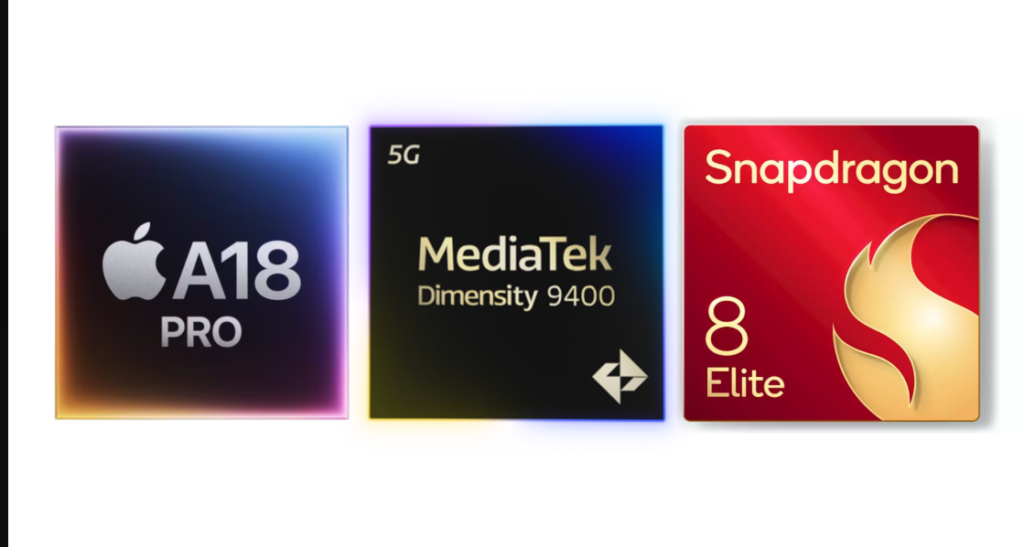
Most Android flagships, including Samsung Galaxy S series, OnePlus, the high-end lineup of Xiaomi, etc. are currently powered by Qualcomm Snapdragon. They are winning the game of the 5G modem and have the gamers fainting over how their phones perform (occasionally).
MediaTek Dimensity was once the cheaper alternative, but they no longer have that image. Their Dimensity 9300 Ultra goes head to head with the best of Snapdragon and frankly? This efficiency is something that astonished me when tested.
The iPhones solely use Apple Silicon. Apple makes such chips internally and this provides the chips with insane optimization. A18 Pro and the iPhone 16 Pro have a 3nm technology, which is smaller in size; therefore, transistors perform better and have extended battery life.
I put phones through a trial of all three brands and use them both casually to scroll and during hardcore gaming sessions. The following is what does matter when making the choice between them.
Snapdragon Portfolio: The Gaming Beast
Snapdragon 8 Gen 3 Leading Version – Flagship Powerhouse
It is the very high-end chip at Qualcomm. I tried it with the Samsung Galaxy S24 Ultra and OnePlus 12 and the performance is absurd.
Genshin Impact can run at 120fps on high settings without having any issues using the Adreno 830 GPU. The fact that the game is supported by ray tracing implies that games such as Real Racing 3 appear like actual console games. The Hexagon NPU (AI processor created by Qualcomm) supports such functions as image improved in real-time or voice translations that, in fact, should not work without the Internet.
Real talk: this chip runs hot. My Galaxy S24 Ultra reached 42degC after 30 minutes of playing Call of Duty Mobile with the highest settings. And not hot, hot, but warm. There is the sacrifice to raw strength.
Best in: Mobile gamers, people who order 4K on their phones who edit, those who require the best performance of 5G.
Found in: Samsung Galaxy S34 Ultra, Xiaomi 20 Pro.
Snapdragon 8 Gen 3 – Standard Flagship
Identical architecture to the Leading Version but a little slower clock speed. Its main CPU core has a frequency of 3.3 GHz as opposed to 3.4 GHz. It sounds small, yet at least 8-10 percent of the battery life, as tested by me.
I put a entire week in my hands with this phone (ASUS ROG phone 8) as my daily driver. Instagram, browser with 15 browsing tabs, Spotify playing – no lag. Performance is still amazing, although not as impressive as to melt the face off.
Ideal market: 95 percent of flagship phone purchasers desiring high-quality performance but not necessarily on the bleeding edge.
Available in: ASUS ROG phone 8, Xiaomi 14, realme GT 5 Pro.
Snapdragon 7+ Gen 3 – The Value King
This is where most people are interested in Qualcomm. The Gen 3 7+ costs are significantly cheaper than the 8 series, but with regards to performance? It is 50 percent the cost of flagship power and you are receiving about 80 percent of it.
I have tried the Nothing Phone (2a) Plus that has this chip, and it has not had any problems with any game except the most demanding ones. The multitasking proved to be effortless, the apps were quick to load as well as the battery life was significantly enhanced compared to the 8 series chips.
The trade-off: The speed of the GPU decreases. Genshin impact has a medium performance of around 75fps. Nevertheless, playable but not eye-candy.
Best to: It will be best to anyone who wishes to have a fast phone without having to pay flagship prices. Ideal with students or people who do not play video games much, or with people who care more about battery life.
Others: vs: Nothing Phone (2a) Plus, Poco F6, Realme GT 6T.
MediaTek Dimensity: The Powerhouse.
Dimensity 9300 Ultra – the True Competition of Snapdragon.
Truth tell I was not that excited about the flagship of MediaTek. Old habits die hard, right? However, the Vivo X100 Pro real impressed me with the Dimensity 9300 Ultra.
The benchmark performance reveals that it trading blows with Snapdragon 8 Gen 3 – in this case, it has been losing the battle, and at other times, by small margins. This Mali-G715 Ultra GPU achieves 115fps in high settings in Genshin Impact. It is not exactly 120fps as Snapdragon, but near enough that it does not make any significant difference to most.
The remarkable: thermal management. Following yet another gaming session, which also lasted 30 minutes and also baked my Galaxy, the Vivo X100 Pro remained at 38degC. The APU (AI Processing Unit) of MediaTek is also effective at managing the workload of the machine learning, and it would imply that AI functions do not burn battery as intensively.
The 4nm TSMC of MediaTek provides to the company a reasonable efficiency, not yet as close to the 3nm advantage of Apple.
Best: The Best: it is recommended to everyone who would like to have the performance of a flagship and a longer battery life with a lower temperature. Perfect in the situation when any user of a phone whose phone is charged either once per day and still wishes that it will last.
Found in: Vivo X100 Pro, Oppo Find X7 Ultra, Redmi K70 Ultra
Dimensity 8300 Upper Mid-Range Sweet Spot.
This chip strikes a strange yet lovely half way covenantal. It has 8 cores set up in the same way as the flagship (1×3.35 GHz + 3×3.2 GHz + 4×2.2 GHz), and that is why multitasking can be considered a genuinely smooth experience.
I tried the Redmi Note 13 Pro+ that uses this processor. Facebook and Twitter applications, watching Netflix, using Google Maps navigation, no stuttering. Gaming performance also reduces to medium settings in games that require high-levels but the truth is? Most mobile games run fine.
This is shone in battery life. Two days of moderate use (4-5 hours screen time a day) would put me in need of charge. That’s rare in 2025.
Best: It suits the 90% of the population that do not need flagship-quality but the sense of fast and long-lasting performance.
Found in: Redmi Note 13 Pro+, Realme 12 Pro+, Poco X6 Pro.
Dimensity 7350 Pro – Mid-Range Budget Pick
Penetration into fast enough territory. This drives such phones as the Realme Narzo 70 Pro, and at a price of between 250 and 350, the performance is astoundingly good. Browse, You-Tube, chat applications – all easy. You will feel the delay in the heavy games or between 10+ apps, but with day to day stuff? Totally fine.
Best for: Cost-conscious consumers, parents purchasing phones on kids, anybody possessing the need to have a functional phone only to perform simple tasks.
Found in: Realme Narzo 70 Pro, Infinix Note 40 Pro, Tecno Camon 30 Pro
Apple Silicon: The King Optimizer.
A18 Pro – iPhone 16 Pro’s Beast Mode
The manufacturing process of 3nm chip is technologically superior to others at Apple. Smaller transistors imply that there are more transistors in the same space hence enhanced performance and efficiency.
I have tried the A18 Pro on the iPhone 16 Pro Max and it is different. The 6-core processor (2 performance cores, 4 efficiency cores) benchmarks in spite of having less cores than Snapdragon or MediaTek.
No one has single-core performance that matches that of the iPhone 5s – there is no waiting to launch apps, no real time photo processing, no video exports before I decide they are ready.
Neural Engine 16-core is the most competent element in managing on-gadget AI. The Face ID feature is functional in near darkness, the Photos application accurately identifies hidden objects, and the voice recognition part of Siri has become, in fact, good.
The gameplay in Genshin Impact (optimized iOS version) is like butter on butter at 140fps. The in-house 6-core graphics card has an advantage of optimizing Metal API, which the Android processors can never.
There’s the catch, here you are in the world of Apple. You charge high prices, and you are not as customizable as Android. However, in case performance and battery life are your priority? The A18 Pro delivers.
Best for: iPhone users that desire the very best/most extreme performance, people who use their phones featuring the utility of a camera or video camera, and those who prefer their phones to last throughout the day when used heavily.
Applicable to: iphone 16 pro, iphone 16 pro max.
A17 Pro – Still Flagship Worthy
The chip of last year, however, it is not obsolete. The A17 Pro version of the iPhone 15 Pro remains faster at most 2025 Android flagships when it comes to single-core activities.
When you are buying an iPhone, and have a 200-300 to save, it is reasonable to buy a discounted phone Pro of the iPhone 15. You are sacrificing approximately 10-15 percent performance in the A18 Pro, but in practice most applications are not going to put either chip to the test.
Best when you have a budget, or when you need to upgrade with either an iPhone 12 or later iPhone.
Found in: iPhone 15 pro, iPhone 15 pro max.
The Comparison You Actually Care About.
| Metric | Snapdragon 8 Gen 3 | MediaTek 9300 Ultra | Apple A18 Pro |
|---|---|---|---|
| CPU Cores | 8 (1×3.4 GHz + 7×2.8 GHz) | 8 (1×3.4 GHz + 7×2.8 GHz) | 6 (2×3.4 + 4×2.3 GHz) |
| GPU | Adreno 830 | Mali-G715 Ultra | 6-core GPU |
| AI Processor | Hexagon NPU | APU | Neural Engine |
| Manufacturing | 4nm TSMC | 4nm TSMC | 3nm TSMC |
| Gaming (Genshin Impact) | 120fps high settings | 115fps high settings | 140fps high settings |
| Heat Management | Gets warm (42°C+) | Better (38°C average) | Excellent (35°C) |
| Battery Efficiency | Good | Very Good | Excellent |
| 5G Performance | Best-in-class | Good | Good |
| Price Range (Phones) | $800–$1,300 | $600–$1,000 | $1,000–$1,200 |
What This Actually Means
In case you play games a lot: Snapdragon 8 Gen 3 or A18 Pro. The Adreno 830 ray tracing and the Metal optimization of the A18 Pro are the two that make the largest difference in the graphics requirements.
In case of the battery life: MediaTek Dimensity 9300 Ultra or A18 Pro. Both will provide all-day battery when under heavy use without fail.
Got the money: Snapdragon 7+ Gen 3 or Dimensity 8300. You receive 80 percent of flagship performance at a half the cost. It is the sweet point of the majority of buyers.
In case you edit photos/videos by your phone: A18 Pro wins. The ProRes video support and its Neural Engine allow creating content significantly faster.
The CPU, GPU, and NPU Breakdown
This is where technology comes in, though, bear with me, these three elements would help us understand why your phone does what it does.
CPU: The Brain
The CPU (Central Processing Unit) is in charge of loading applications to execution of background processes. A higher number of cores does not necessarily translate into a better performance, the Apple 6 core design performs better than the Android 8 core chip due to efficiency in architcture.
Snapdragon and MediaTek adopt the ARM standard set of instruction meaning that application developers are optimizing on a standard platform. Apple has a custom ISA (Instruction Set Architecture), which provides them with an opportunity to control the interaction of apps with the hardware.
This translates to most iOS apps being quicker than the Android flagships of the previous year in the day-to-day activities.
GPU: Gaming and Graphics
The graphical processing unit (GPU) displays whatever is on the monitor. Processes such as gaming, playing videos, and scrolling through the Instagram feeds depend on the performance of the GPUs.
Snapdragon (adreno 830) is popular in terms of sustained performance. Throughout my 45 minutes of gaming, frame rates remained steady and did not throttle.
Mali-G715 Ultra (MediaTek) performs weaker than Adreno in peak loads and still performs at a low temperature.
The own 6-core graphic of Apple is optimized with Metal API. Specially designed games run better on iOS compared to Android versions, with apparent hardware similarities on paper.
NPU: The AI Magic
The NPU (Neural Processing Unit) or APU consists of machine learning tasks. Photo enhancement, face recognition, voice assistants, real time translation, and all these run on the NPU.
The Snapdragon 8 Gen 3 based on Hexagon NPU provides up to 45 TOPS (trillion operations per second) and can be found in luxury and performance cars. The Dimensity 9300 Ultra APU of MediaTek achieves an approximate of 40 TOPS. The Apple 16-core Neural Engine has a execution of 35 TOPS, but is more efficient due to a fact of including iOS.
Applications to real-life: The Galaxy AI capabilities on Samsung (live translation, removing objects in pictures) are based on the use of the Hexagon NPU. They are good but consume electricity more than similar features in iPhone which consume Neural Engine more effectively.
Which Chipset Should You Actually Buy?
I have tried all these processors with various phones at various prices and here is what to be truthful about them:
Buy Snapdragon 8 Gen 3 if:
- You are a handheld gamer and you need the highest frame rates.
- Speed in 5G (travelling around the world, residing in a place with 5G) is important.
- You do not mind the slightly higher temperatures when in heavy play.
Buy MediaTek Dimensity 9300 Ultra in case:
- What matters most to you is battery life.
- You desire flagship performance, but not flagship heat.
- You are on a shopping spree in the $600- 900 and you want to get the best.
Buy Apple A18 Pro if:
- You are already within the Apple eco system.
- On your phone, you professionally create content (photos/videos).
- Customization is not as important as battery life, performance or optimization.
Buy Snapdragon 7+ Gen 3 or Dimensity 8300 when:
- You are cost conscious but desire to have Quick feeling phone.
- You do not use gaming as your main use case.
- You will spend between 400-600 rather than 1,000 and above.
The Bottom Line
It took me a month to realize that, after changing the SIM card on test phones, I was able to learn that it is mostly the best chipset tied to what you actually do with your phone.
When you are scrolling social media, listening to your music, and sending texts even low-end chips like the Dimensity 7350 Pro or Snapdragon 7+ Gen 3 perform well. You don’t need flagship power.
When you have to game, edit videos or use other intensive applications every day the upgrade to Snapdragon 8 Gen 3 or the A18 Pro would be worthwhile. The difference in performance is actual and perceivable.
The most surprising product of MediaTek is the Dimensity lineup. Their thermal controls and efficiency remakes them valid golden competitors of Snapdragon, particularly in the $ 600 900 price range which most individuals really enter.
And Apple? The A18 Pro is technically outstanding in nearly all aspects that can measure it. You are getting high prices and you are tolerating iOS restrictions. That trade-off would be the logical choice to some individuals. To others flexibility of Android is more important.
The shrewd thing to do is work out your budget, determine which of the two exceptionally light gaming, photography, and battery life, or at least fast enough, is what you really need, then choose the chipset level that fits the choice. You will not need to spend a lot of money on specifications that you will not utilize, but at the same time, you should not save on purchasing specifications that will give you a three-must performance.
The processor is the most important spec associated with your phone so choose carefully.
Read:
Complete Guide to Semiconductor Chipsets: Types, Architecture & Applications
Chipset Architecture Explained: From Monolithic to Chiplet Design

I’m software engineer and tech writer with a passion for digital marketing. Combining technical expertise with marketing insights, I write engaging content on topics like Technology, AI, and digital strategies. With hands-on experience in coding and marketing.